DSPy's abstractions worked for us, but its runtime didn't
I greatly enjoyed Skylar Payne’s write-up on DSPy. I felt it would be helpful to share my experiences building production workflows with DSPy for two separate projects in 2025 at Not Diamond.1
This is that post. Thanks, Skylar, for the well-written kick-to-the-butt.
Learning the library v. using it
I agree with the criticality of signatures, modules and optimizers in modern AI workflows. DSPy uses these concepts to great effect; between that, its comprehensive library of prompt-optimizing algorithms, and its excellent documentation, we quickly learned the library.
That said, I tried to apply DSPy to a specific flavor of distributed system: async-optimized throughput, cross-provider targets, supporting multi-workflow stakeholders in enterprise settings. Its runtime didn’t work with our production system, however, so we pulled it.
Conflicting concurrency
Both of my team’s attempts at integrating DSPy into live workflows involved distributed, asynchronous training and dynamic model-switching via Celery with gevent. We abandoned DSPy shortly after encountering this configuration issue:
if not in_ipython and config_owner_async_task != asyncio.current_task():
	raise RuntimeError(
		"dspy.configure(...) can only be called from the same async task that called it first. Please "
		"use `dspy.context(...)` in other async tasks instead."
	)
So we used dspy.context, as suggested to avoid async task conflicts. As mentioned before, though, we wanted to switch models, which obligated this example snippet:
with dspy.context(lm=dspy.LM("openai/gpt-5-mini")):
    result1 = predict(question="Who is the GOAT of soccer?")

with dspy.context(lm=dspy.LM("openai/gpt-5-nano")):
    result2 = predict(question="Who do *you* think is the GOAT of soccer?")
While DSPy 3.0 shipped async improvements, limitations in configurability and async support still persist:
- program training seems to require a synchronous context
dspy.settingshas mixed support across coroutines- multi-model workflows have limited support across different concurrency models
More broadly, this design tightly couples DSPy’s runtime to your production setting. By optimizing your program with DSPy, you’ve also bought into the library’s architectural decisions for concurrency. This is no more evident than in the FastAPI tutorial, where the user’s concurrency management must be deferred to DSPy via dspy.asyncify.
Our production deployment requires performance optimizations tailored to the needs of our workflows, instead of those of a library dependency. To avoid conflicts between Celery and DSPy’s concurrency management, we essentially distributed prompt optimization by model and ran each optimizer serially within a task.
This architecture wrecked the system’s overall throughput. DSPy’s optimizers were now the slowest part of our optimization stack.
Pulling prompts
Once optimization completed, we encountered additional challenges when porting optimized prompts out of the distributed tasks. These prompts needed to pass human review for use in workflows which did not depend on DSPy, or existed outside of automated pipelines altogether (like AI chat interfaces).
Let’s say you want to use your optimized prompts outside of DSPy. You’d have to extract prompts like this:
{
  name: adapter.format(
    p.signature,
    demos=p.demos,
    inputs={k: f"{{{k}}}" for k in p.signature.input_fields},
  )
  for name, p in program.named_predictors()
}
Note that many of DSPy’s optimizers2 treat signatures as optimizable parameters. If the user decouples those components from the underlying prompts, they can inadvertently unwind performance gains. Users should preserve DSPy’s programs as-is.
But these programs do not willingly exit the DSPy runtime. We attempted to extract programs using the above snippet, as well as applying various scripts to DSPy’s JSON I/O options and its Signature and ChatAdapter classes. None of these approaches ultimately met the requirements of our end users for workflow compatibility and human understanding.
Dealing with dependencies
Our production runtime deploys into environments with tighly-constrained requirements, so we require control over our supply chain. DSPy, however, executes all of its LLM client requests via LiteLLM. Introducing DSPy meant accepting LiteLLM into our carefully-curated environments and observability stack.
I’ve found that LiteLLM presents significant issues in non-trivial production contexts. The library introduces verbose, poorly-formatted logs at INFO level, which polluted Datadog and our local testing tools:3
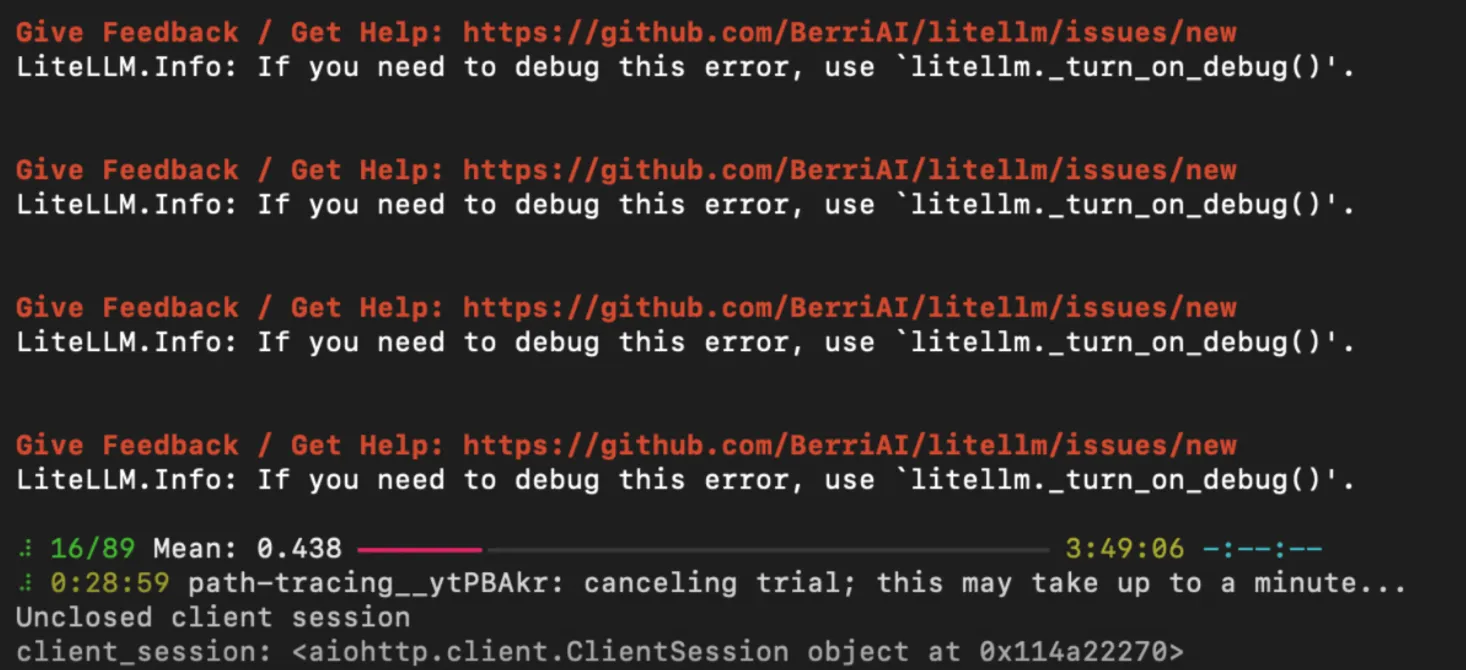
Our supply chain requirements extend to security concerns, so it’s worth noting LiteLLM recently experienced a supply chain vulnerability, where a core maintainer’s PyPI credentials were seemingly compromised.
We overcame these challenges by building our own client logic with openai.OpenAI and tenacity which extends across structured outputs and function calling.4 As of today there’s broad support for chat.completions across AI providers. Our in-house client library works comprehensively and reliably, thanks to strong compatibility with our observability stack.
What it is and what it is not
If you need to manage your own concurrency, port your prompts to different settings, or keep an orderly deployment environment, you might find that DSPy’s dependency stack and runtime don’t fit your needs.
For other scenarios, though, DSPy can help launch and optimize your workflow prototypes very quickly, and its concepts will endure well into the production phase of your project.
Thanks to Devansh Jain and James Kunstle for input on this write-up.
Footnotes
-
Astute readers will note that one of our products at Not Diamond is Prompt Optimization. If you haven’t closed this tab yet, I solemnly vow to avoid any sales in this post. ↩
-
Notably, this is not true of GEPA, where users can seamlessly extract prompts from the optimized adapter. While GEPA is available in DSPy, this capability is primarily available in the underlying
gepa-ailibrary. ↩ -
Honestly, “Local Engineer Complains About Dependency Logging Configs” is the least surprising headline of the day! But LiteLLM’s usage of
INFOfor low-signal logs feels disconnected from common logging practices in production systems. ↩ -
I expect most AI engineers writing Python have battle scars with
openai.OpenAIandtenacity.retryat this point.RETRYABLE_HTTP_ERROR_CODESshould be a permanent fixture of Pythonic AI project templates. ↩